


A common launch-day problem is that a game can support the expected number of players once they are connected, but the login path cannot handle all of those players arriving at the same time. Authentication, player data, entitlements, sessions, and other startup services can all receive a short burst of traffic that is much higher than their normal operating load.
A login queue is one way to control that burst. It acts as admission control between players trying to log in and the services that process them, allowing new players through at a rate the system is expected to handle safely. It does not increase backend capacity, so the useful part of the design is deciding what you are trying to protect, how quickly players should be admitted, and how the game should behave while they are waiting.
1. A Launch Spike Is More than a CCU Problem
When preparing for launch, it is easy to focus on concurrent users: how many players can the game support at once? That number matters, but it does not describe the whole login workload.
Before a player reaches the game, the login flow may involve authentication, loading player information, checking entitlements, creating or restoring sessions, and calling other backend services. If thousands of players enter that flow within a short period, one of those dependencies can become a bottleneck even if the game would otherwise support the resulting player count.
Retries can make this worse. If a request times out and the client immediately tries again, the backend may receive additional work while it is already recovering from the original spike.
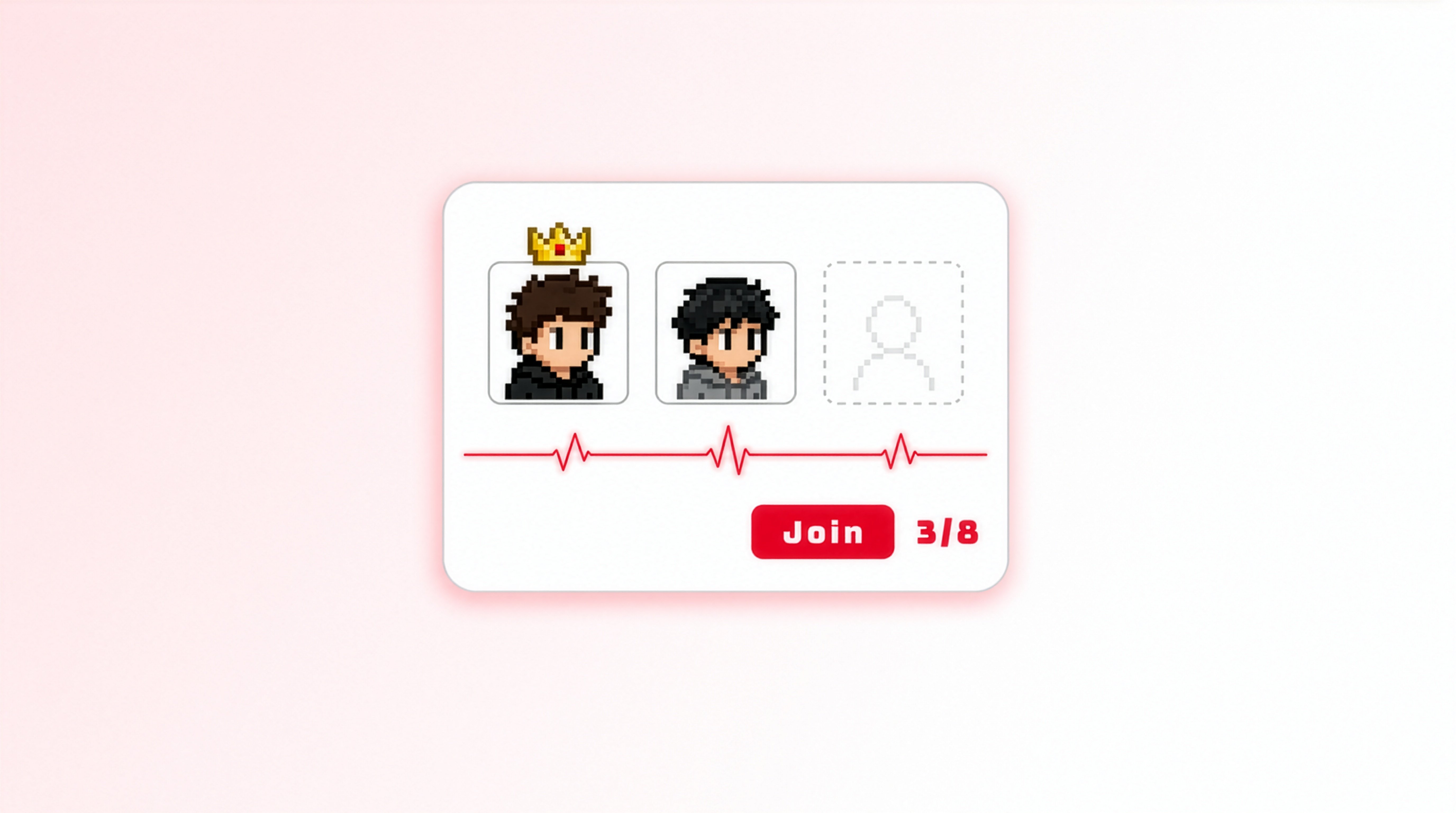
With admission control in front of that flow, some players can continue while the rest wait.
A login queue does not create additional capacity. It controls how quickly new login traffic reaches the services behind it, which can be useful when the system supports the expected player population but cannot absorb the same number of players arriving at once.
2. Find the Bottleneck Before Configuring the Queue
Before configuring a queue, you need to know which part of the login path you are trying to protect. That may be game-server capacity, but it could also be authentication, player data, session creation, or another dependency used shortly after login.
This matters because a queue only helps when it limits traffic before the relevant bottleneck. If the constrained service is elsewhere in the flow, adding admission control at the wrong point may have little effect.
For example, imagine load testing shows that the complete login path remains stable while creating roughly 500 new sessions per minute. If 2,000 players arrive during that minute, allowing all 2,000 through immediately does not make the system capable of processing them faster. A more useful approach would be to admit players around the rate that has been tested and keep the remaining players waiting.
The important point is that the admission rate should come from testing the system behind the queue, not from picking a value in the configuration screen. It is also worth testing above the expected safe rate so you can see which dependency begins to degrade first and what that failure looks like.
A login queue is therefore not a replacement for capacity planning. If the system is already close to its limit during normal traffic, reducing the admission rate may only delay the same underlying problem.
3. Concurrency and Admission Rate Solve Different Problems
Concurrency and admission rate are related, but they describe different limits. Concurrency is the number of players the game and backend can support at the same time, while admission rate is how quickly new players can enter the system.
A game may be able to support a large number of connected players while still having a much lower safe login rate. This is because logging in can involve short-lived but relatively expensive operations that do not occur at the same rate once players are already in the game.
This distinction matters during a launch or large update because the same number of players can produce very different backend load depending on whether they are already connected or are all trying to enter at once.
AGS Login Queue exposes these two controls separately through Max Concurrency and Max Login Rate per Second. It also provides settings for safety margin, reconnect grace periods, and polling. The configuration gives you the controls, but the values still need to come from what you know about the game and its backend limits.
4. Mapping the Decision into Login Queue Configuration
Once you have an admission policy you want to enforce, you can map it into the Login Queue configuration in the AGS Admin Portal.
In AGS, Login Queue is configured under:
Foundations → Tools & Utilities → Login Queue
The configuration includes values such as Max Concurrency, Max Login Rate per Second, Safety Margin, reconnect grace periods, and Polling Time.
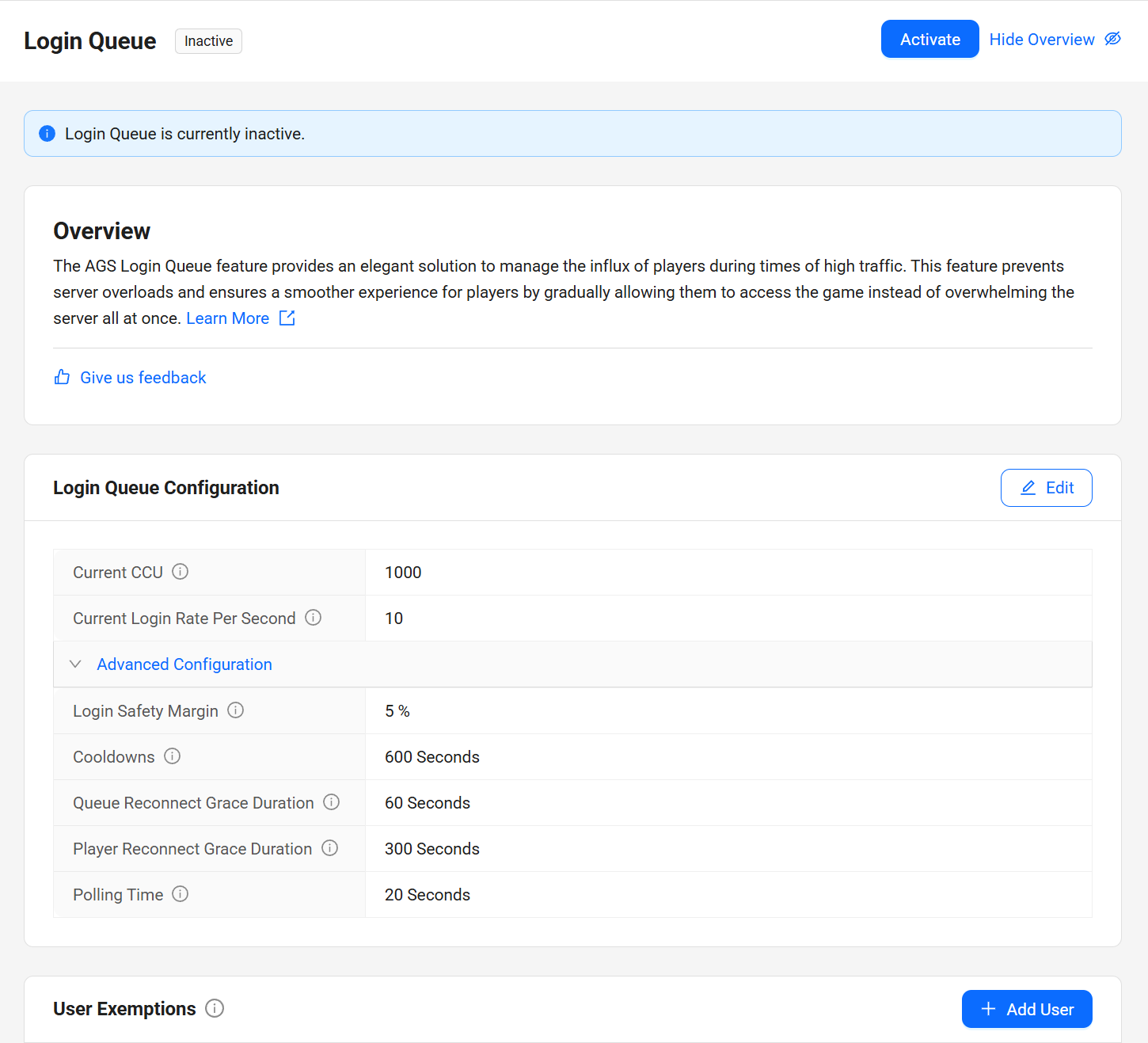 AGS Admin Portal: Login Queue Configuration
The Byte Wars tutorials use values that make the queue trigger quickly so the feature can be demonstrated and tested without a large number of clients. Those values are useful for a tutorial, but they should not be treated as production recommendations.
For a real game, the configuration should reflect what has been measured during load testing. If the login path starts degrading above a certain rate, that result gives you a starting point for the admission limit. You should still leave enough margin for normal variation and test the configuration under conditions that are close to the traffic pattern you expect at launch.
Reconnect settings also need some thought because they affect the player experience directly. A player who briefly loses their connection while waiting should not necessarily lose all progress in the queue, and a player who was already admitted may need different reconnect handling from someone who has not entered the game yet.
5. The Game Still Has Work to Do
Enabling a backend queue adds another state to the login flow, so the game client needs to handle more than success or failure.
Without a queue, a simplified login flow might look like this:
Once admission control is involved, the client also needs to represent a waiting state and react to updates from the queue.
The UI does not need to be complicated, but it should make the current state clear. A player should be able to tell that they are waiting rather than disconnected, whether their queue ticket is still active, whether position or estimated wait information is available, and whether they can cancel.
It is also important that the UI does not encourage behavior that makes the situation worse. If pressing Login again will not help, the player should not be left guessing. If the backend cannot produce a reliable wait estimate, the client should avoid presenting one as if it were precise.
6. Keeping the Integration Engine-Agnostic
The exact SDK calls and engine classes are different between Unreal Engine and Unity, but the responsibilities are similar. The game needs an integration layer that receives queue state from AGS and turns it into application-level events the login flow and UI can use.
Conceptually, the relationship looks like this:
Our Byte Wars reference implementations show this pattern in both engines. In Unreal Engine, Byte Wars wraps the AGS Online Subsystem identity interface in a Game Instance Subsystem. The subsystem receives the queue-related callbacks and provides a game-facing layer that the UI can use without dealing directly with the OSS integration.
The specific Unreal class is less important than the separation itself. Keeping backend integration details behind a game-facing layer means the waiting screen only needs to care about states such as queued, updated, cancelled, or admitted.
The Unity Byte Wars module implements the same overall feature using the Unity SDK. Its implementation is different at the code level, but it follows the same general responsibility split between the SDK integration, game login flow, and player-facing UI.
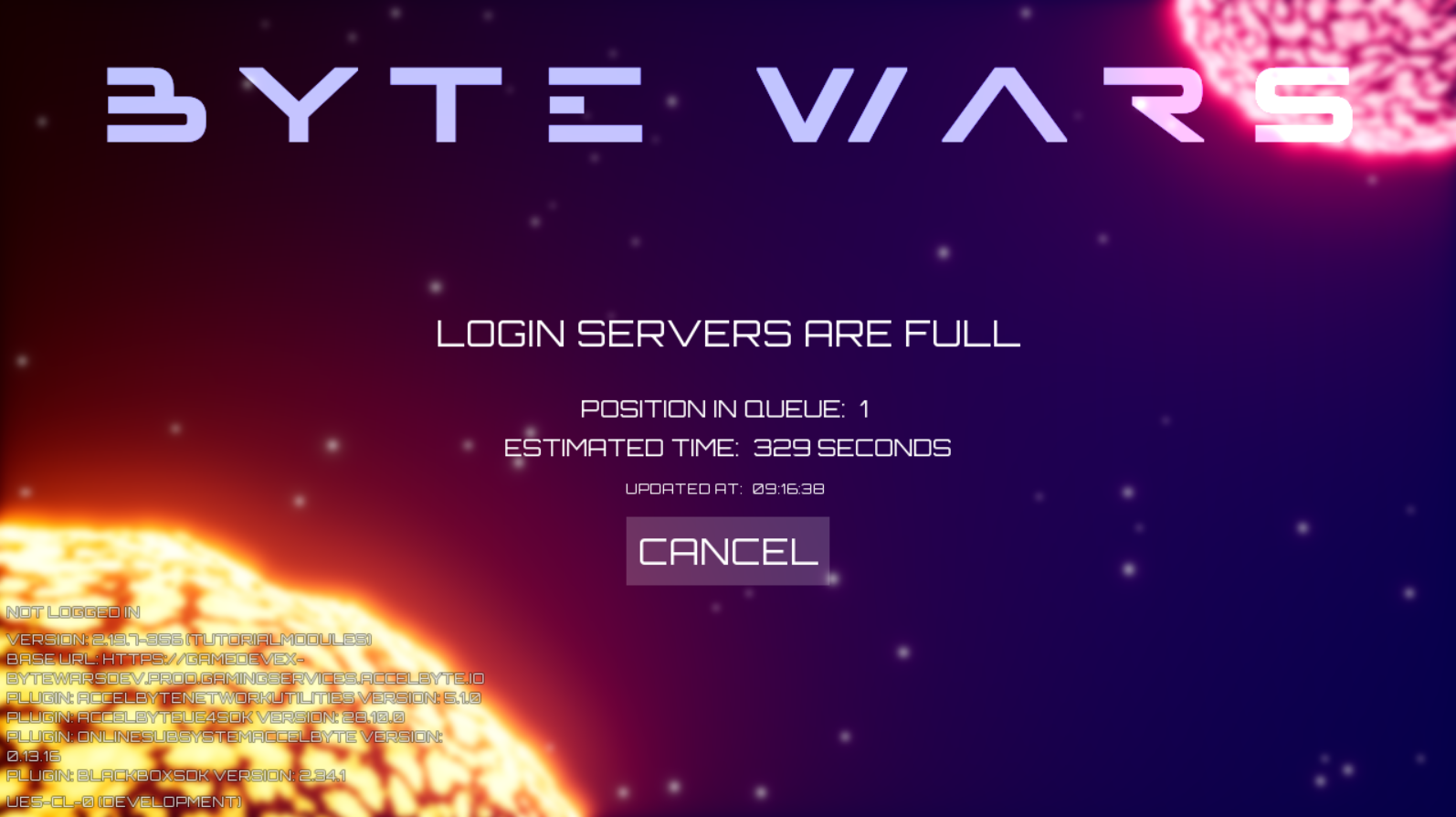 Byte Wars waiting in Login Queue
The full implementation details already exist in the Byte Wars tutorials, so this article does not need to repeat them:
Those tutorials cover the engine-specific setup, UI, callbacks, cancellation flow, and playtesting. The purpose here is to explain where those pieces fit in the overall login design and what needs to be considered before choosing the configuration.
7. Test the Cases that Break the Happy Path
A basic test where one client enters the queue and eventually logs in only proves the normal flow. Before relying on the queue for a real launch, it is more useful to test the conditions that are likely to expose problems in the admission policy or client behavior.
Sudden Traffic Spike
Start from normal traffic, then introduce a large number of login attempts over a short period. Watch both the queue and the services behind it.
The main thing to verify is that admission starts being limited before the protected dependency becomes unhealthy. If that service begins timing out before the queue has any meaningful effect, the queue may be protecting the wrong limit or the admission rate may still be too high.
Disconnect While Waiting
Put a player into the queue, interrupt the connection, and then bring the client back. Check both the backend state and what the player sees.
The important questions are whether the player keeps their queue state, how long the reconnect window lasts, and what happens when that window expires. The client should also represent the reconnect clearly; a backend grace period is not very useful if the game immediately throws the player back to an unrelated login error.
Retry Behavior
Retry behavior is worth testing separately because it can create extra traffic during the exact period when the system is under pressure. For example, a player may assume the login has stalled and press Login again while the original request is still active.
The queue controls admission, but it does not automatically make the rest of the client login flow retry-safe. The game should avoid creating multiple overlapping login attempts for what the player believes is a single action.
Admit Too Quickly
During load testing, increase the admission rate until one of the protected dependencies begins to degrade. This helps confirm whether you have identified the correct bottleneck and gives you a clearer picture of the operating margin rather than relying on a value that merely looks conservative.
You do not need to run production at the failure threshold. The point of finding it is to understand where the limit is and leave appropriate headroom below it.
Queue Drain
It is also worth testing what happens after the traffic spike has passed. The queue should drain, waiting players should continue being admitted, and the downstream services should return to their normal operating state without manual intervention.
This recovery path can be easy to overlook if most of the testing focuses only on getting players into the queue.
8. When a Login Queue Is and Isn't the Answer
A login queue is useful when there is a known limit in the login path and controlling the rate of new traffic helps keep that part of the system within a safe operating range. It is less useful when expected traffic is already comfortably below tested capacity, because in that case the queue adds another state for both the game and the player without solving a real problem.
It will also not fix a bottleneck that sits outside the part of the flow being controlled. If the actual constraint is a different service or a later gameplay system, adding a queue in front of authentication may simply move where the symptoms appear.
For that reason, I would treat the queue configuration as the last part of the decision rather than the first. The more important work is measuring the login path, identifying the constrained dependency, deciding how quickly new players can safely enter, and making sure the client handles waiting, reconnecting, and cancelling in a predictable way.
If you want to see the complete implementation, the Byte Wars tutorials show the Login Queue flow in both Unreal Engine and Unity, including Admin Portal configuration, client integration, UI handling, and playtesting.
Try the login flow before you need it
If you are preparing an online game for a launch, update, or live event, you can configure the Login Queue in AccelByte Gaming Services and run through the Byte Wars examples in Unreal Engine or Unity. Use the sample implementation to get the client states working, then test the limits against your own backend and traffic patterns.
You're almost signed up!
Verify your account by following the instructions sent to .
If you still haven't received an email, please check your spam folder.
Featured Blog Posts



Bring your first player online today.
Get started for free, and scale as your game grows.